Sindh Declares All-Out War on Plastic Bags from June 15
KU chancellor Iraqi and other urge awareness through education to Fight Climate Crisis
The pagelayer doesn’t support this content. You can leave this block intact or remove it completely.
Sindh Declares All-Out War on Plastic Bags from June 15
The pagelayer doesn’t support this content. You can leave this block intact or remove it completely.
KU chancellor and other urge awareness through education to Fight Climate Crisis
The pagelayer doesn’t support this content. You can leave this block intact or remove it completely.
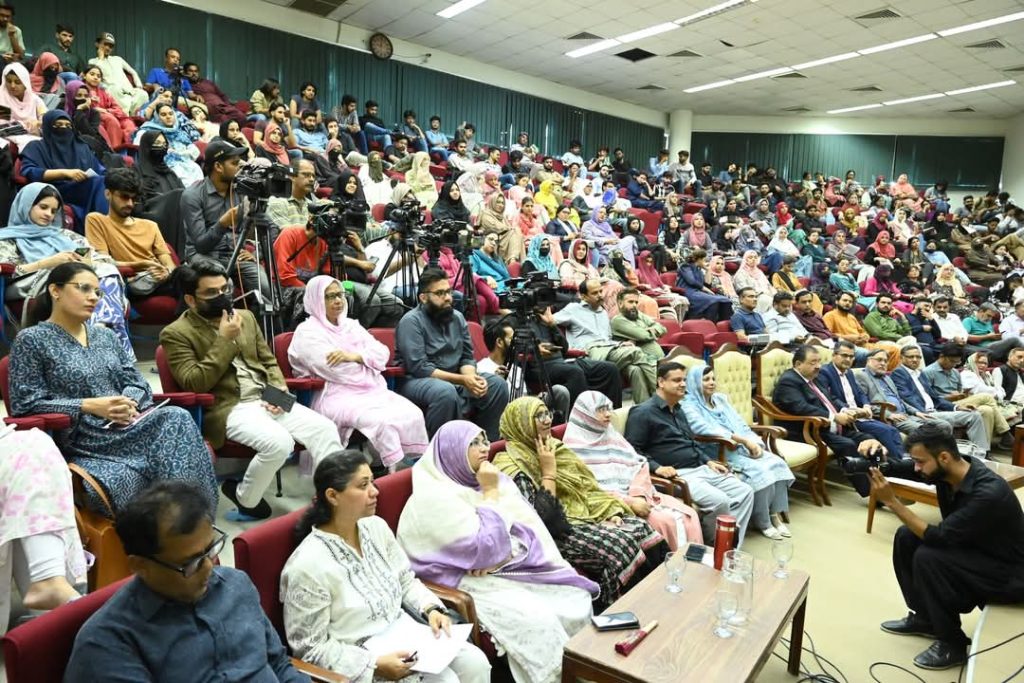
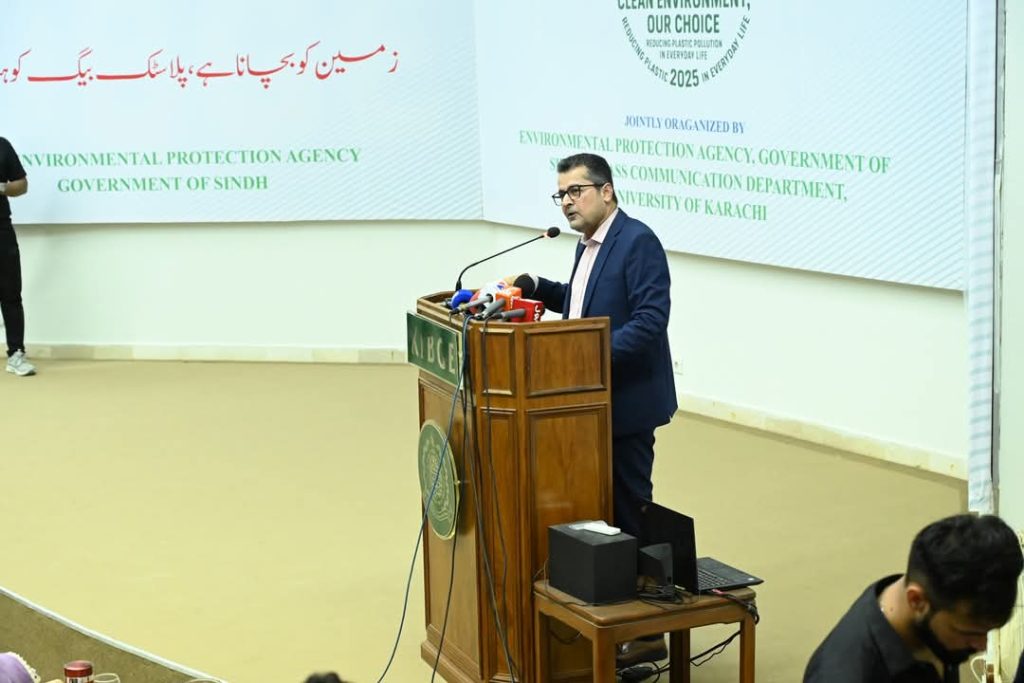
KARACHI: As the world stands at a critical crossroads in the fight against climate change, Sindh has taken a bold step by imposing a province-wide ban on plastic bags effective from June 15, 2025. In a significant collaborative effort to mark World Environment Day, the Sindh Environmental Protection Agency (SEPA) and the Department of Mass Communication at the University of Karachi (KU) organized a high-profile seminar titled “Reducing Plastic Pollution” at the Dr. A.Q. Khan Institute of Biotechnology & Genetic Engineering. The event brought together environmental scientists, academics, government officials, and civil society stakeholders to confront the mounting threat posed by plastic waste and its consequences on Pakistan’s already fragile ecosystems.
The pagelayer doesn’t support this content. You can leave this block intact or remove it completely.
Amidst growing global concern over environmental degradation, speakers at the event emphasized that Pakistan—especially the Sindh province—is on the frontlines of the climate emergency. Heatwaves, water scarcity, urban flooding, and habitat destruction are no longer distant threats but part of the daily lived experience of millions across the country. Experts argued that the environment must not be viewed as a secondary issue or a one-day concern tied to annual observances, but rather as a core national priority demanding sustained commitment from every sector of society.
The pagelayer doesn’t support this content. You can leave this block intact or remove it completely.
In his keynote address, KU Vice Chancellor Professor Dr. Khalid Mahmood Iraqi warned that climate change is not a theoretical future risk but a present and worsening crisis for Pakistan. “This is not merely a shift in climate — it’s a warning. If we fail to act now, regret will be our only companion in the near future,” he stated. Dr. Iraqi drew attention to alarming trends in glacier melt, rising sea levels, and erratic rainfall patterns, all of which are rapidly undermining Pakistan’s water security. He stressed the urgent need for both structural and cultural transformation—especially in terms of reducing plastic consumption and promoting biodegradable alternatives.
The pagelayer doesn’t support this content. You can leave this block intact or remove it completely.
Citing that 98% of single-use plastic bags are non-recyclable and non-biodegradable, he called for a complete elimination of plastic availability at commercial outlets and urged policymakers to ensure affordable, accessible, and eco-friendly substitutes. “We need more than awareness — we need behavioral change,” Dr. Iraqi asserted, highlighting that universities must play a central role in shaping this new environmental consciousness.
The pagelayer doesn’t support this content. You can leave this block intact or remove it completely.
The pagelayer doesn’t support this content. You can leave this block intact or remove it completely.
“We need more than awareness — we need behavioral change,” Dr. Iraqi
The pagelayer doesn’t support this content. You can leave this block intact or remove it completely.
Representing the Sindh government, Secretary for Environment, Climate Change and Coastal Development Agha Shah Nawaz Khan formally announced that all plastic bags would be banned across Sindh starting June 15. “Plastic shopping bags are not only an environmental hazard, but they also wreak havoc on our sewerage systems. A province-wide crackdown will begin mid-June, starting with major cities like Karachi, Hyderabad, Mirpurkhas, and Larkana,” he stated. Khan explained that the policy was finalized after extensive consultations with manufacturers, retailers, environmental bodies, and civil society organizations to ensure successful enforcement and broad-based support.
The pagelayer doesn’t support this content. You can leave this block intact or remove it completely.
The pagelayer doesn’t support this content. You can leave this block intact or remove it completely.
”A province-wide crackdown will begin mid-June” Agha Shah Nawaz
The pagelayer doesn’t support this content. You can leave this block intact or remove it completely.
He revealed that over 11 million tonnes of plastic waste enter the global environment each year, contaminating soil, groundwater, and even the food chain. “Pakistan must now move toward a circular economy — one that minimizes waste, recycles resources, and invests in environmental sustainability,” he emphasized.
The pagelayer doesn’t support this content. You can leave this block intact or remove it completely.
The pagelayer doesn’t support this content. You can leave this block intact or remove it completely.
SEPA’s Director General, Waqar Hussain Phulpoto, echoed these sentiments and stressed the importance of public support. “This initiative can only succeed if people themselves believe in it. We’ve given industries time to develop alternatives. Now, it is time for legal enforcement and citizen compliance,” he said. Phulpoto revealed that SEPA is launching a widespread public awareness campaign alongside legal action, promoting the use of cloth bags and discouraging both plastic bags and bottles. “Reducing plastic is not an environmental luxury—it is a necessity for survival,” he added.
The pagelayer doesn’t support this content. You can leave this block intact or remove it completely.
Highlighting the role of education, Phulpoto praised SEPA’s partnerships with universities and student-led campaigns as a foundation for community-level change. “Awareness needs to begin in classrooms and extend to neighborhoods, markets, and government offices,” he remarked.
The pagelayer doesn’t support this content. You can leave this block intact or remove it completely.
The pagelayer doesn’t support this content. You can leave this block intact or remove it completely.
SEPA’s partnerships with universities and student-led campaigns as a foundation for community-level change. Phulpoto
The pagelayer doesn’t support this content. You can leave this block intact or remove it completely.
Professor Dr. Samina Saeed, Dean of Arts and Social Sciences at KU, reminded participants that environmental protection is not just a scientific or policy issue, but a deep moral and social responsibility. “We must empower communities and cultivate a culture of care that transcends generations,” she said. Dr. Saeed emphasized that lasting impact comes not from one-time clean-up drives, but from fostering values of sustainability in children, students, and families.
The pagelayer doesn’t support this content. You can leave this block intact or remove it completely.
Chairperson of the Mass Communication Department, Dr. Asmat Ara, added that rising temperatures and worsening air quality in Karachi and broader Sindh are a direct result of unrestrained urbanization and environmental neglect. “We have already planted over 4,000 trees on our campus in collaboration with WWF, but this is just the beginning,” she stated. “Awareness without action is meaningless. We must match words with green deeds.”
The pagelayer doesn’t support this content. You can leave this block intact or remove it completely.
Former Chairperson of KU’s Geography Department, Professor Dr. Jamil Hasan Kazmi, issued a powerful warning against shortsighted urban environmental policies. He criticized the introduction of non-native ornamental plants and the lack of long-term research in environmental planning. “The consequences of ill-informed decisions are long-lasting and can be irreversible. Urban ecology must be handled by professionals who understand its complexity,” he said.
The pagelayer doesn’t support this content. You can leave this block intact or remove it completely.
The pagelayer doesn’t support this content. You can leave this block intact or remove it completely.
The consequences of ill-informed decisions are long-lasting and can be irreversible. Dr. Jamil Hasan Kazmi,
The pagelayer doesn’t support this content. You can leave this block intact or remove it completely.
The seminar concluded with a strong consensus among all speakers that Sindh’s plastic ban is a vital and overdue step — but it is only the beginning. Policies are necessary, but they must be complemented by education, enforcement, affordability of alternatives, and, most importantly, collective will. The challenge is immense, but so is the opportunity to forge a cleaner, greener, and more resilient future for generations to come.
The pagelayer doesn’t support this content. You can leave this block intact or remove it completely.
If Pakistan is to withstand the shocks of the climate crisis, experts agreed, it must move swiftly from reactive policy to proactive environmental stewardship — one that includes every citizen, institution, and industry in its vision
The pagelayer doesn’t support this content. You can leave this block intact or remove it completely.